

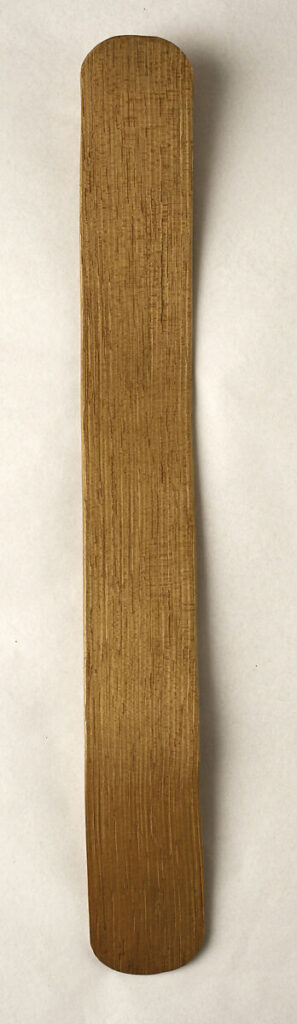
A firm support at the centre front of stays or a corset. Older examples could be a single insert; many later corsets use a two-part metal busk that also fastens the garment.
The longer story
Busk is a useful warning against assuming that one clothing word always names one mechanism. An earlier busk might be a single stiff insert placed at the centre front of a supporting garment. A later split busk combines support with a fastening. The position links the ideas; the construction distinguishes them.
Imagine the difference between a firm strip held inside a garment and two narrow parts that can separate. In the first case, the object supports a line without itself opening the front. In the second, the centre front can also function as a closure. This distinction matters when looking at a costume illustration: a row of fasteners is evidence of a different arrangement from an uninterrupted insert.
Materials and decoration add further variety. Surviving busks are not all industrial-looking metal fittings. Museum collections include carved wooden examples and ornamented pieces whose visible detail seems surprisingly elaborate for an object associated with the inside of clothing. Private or partly concealed surfaces can still receive considerable attention.
This makes the busk an interesting object of design rather than merely an emblem of restriction. To understand a particular example, ask what garment it belonged to, how it was positioned and what its surface records. Avoid turning every supporting garment into the same story. A precise material description and a date do more work than a sweeping judgement about several centuries of dress.
At the festival
At the festival, a costume’s front line may evoke historical support without reproducing its complete internal structure. A conversation with the maker can distinguish the visible effect from the construction underneath. The interesting question is how the chosen silhouette was achieved for this particular wearer and occasion, rather than how tightly anything can be worn.
On the page
The Met’s eighteenth-century wooden busk explains the earlier insert form. Its collection also includes a French seventeenth-century metal example associated with Anne-Marie-Louise d’Orléans, bearing personal and amorous imagery and inscriptions. Read those records as evidence of individual objects: the hidden location of a fitting did not prevent it from receiving elaborate attention.
On screen and in play
In a fictional costume workshop scene, a single insert and a split fastening laid side by side could explain the vocabulary without a lecture. The props would show two solutions to related design needs. An illustration can make the distinction equally clear by drawing the centre line once closed and once separated.
Related words Aglet · Stays · Slashing · Paned sleeves
