

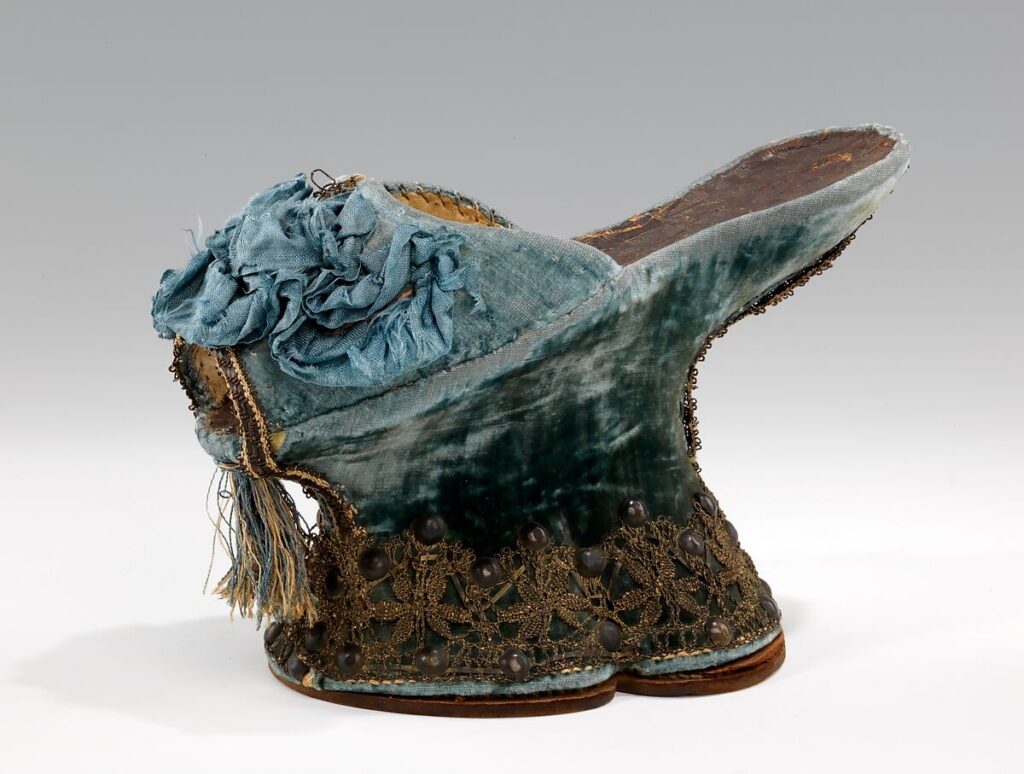
A historical shoe raised on a platform, notably associated with Renaissance Venice. Some examples reach startling heights. The silhouette is memorable; it isn’t a sensible guide to everyday festival footwear.
The longer story
A chopine raises a shoe into an architectural proposition. Its platform creates height beneath the foot, rather than relying simply on a separate high heel. The result changes the wearer’s apparent height and the relationship between footwear and the clothing above it. That relationship is central to understanding the object.
Venetian examples are particularly familiar in museum discussions, but the temptation is to let the most extreme surviving pair stand for all wearers and all occasions. Heights and materials vary. A spectacular object may have been preserved partly because it was spectacular, so the museum case is not a statistical sample of an ordinary street.
The platform also complicates the line between practical separation from the ground and conspicuous display. A costly covering can be admired for its finish while belonging to an object whose lower portion meets the street. Those competing demands make the shoe more interesting than a simple claim that people wanted to avoid mud or look taller.
When looking at an example, separate the place where the foot rests from the structure below it. Then examine how the upper holds the foot and how the covering relates to the base. This is a reading exercise, not a suggestion to reproduce the height. The silhouette can be understood very well on a page, where no one needs help crossing the room.
At the festival
For festival inspiration, a drawing or accessory motif can borrow the chopine’s distinctive stepped outline. Comfortable present-day footwear can remain part of the actual outfit. If discussing an extravagant historical shoe, keep the focus on materials, scale and display. The object provides plenty to talk about without turning an unfamiliar platform into a walking challenge.
On the page
The Met’s Italian chopines dated 1590–1610 offer a concrete study in elaborate footwear. The catalogue discusses both elevation above the street and sartorial prominence. Another pair, dated 1550–1650, invites comparison. The broad dates are worth retaining: an object’s museum label can preserve uncertainty more honestly than a costume caption naming a single year.
On screen and in play
In an imagined exhibition animation, the shoe could be shown beside a plain foot outline and a hemline. Raising the platform would visibly change the relation between all three. This kind of explanatory movement would teach more than a comic sequence about stumbling, which reduces an unfamiliar fashion to an easy joke.
Related words Pattens · Poulaines · Surcoat · Houppelande
