

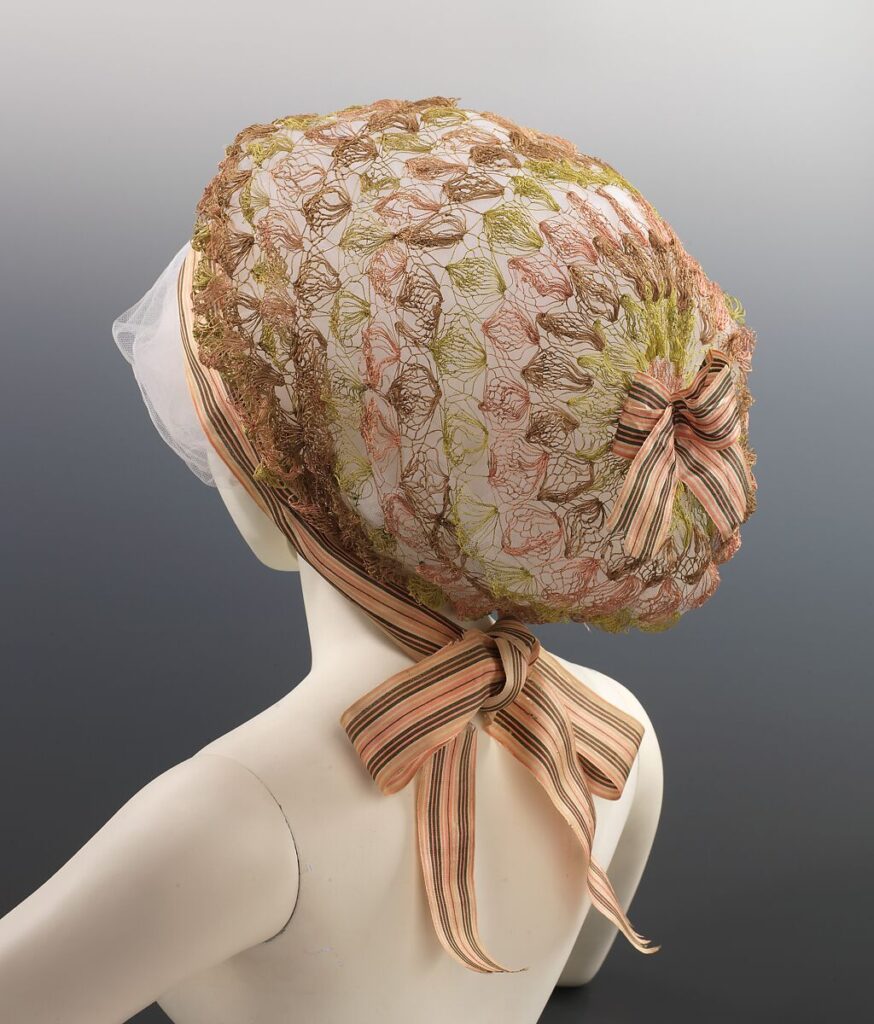
Here, a net or bag-like covering that holds the hair at the back of the head. The word also names a modern tubular scarf, so check which end of the wardrobe is being discussed.
The longer story
Snood is one of those words that can make two people agree while imagining different objects. In modern clothing it can name a tubular neck covering. Here we mean the hair-covering sense: a net or pouch that contains the hair towards the back of the head. Stating the sense first saves a surprisingly long conversation.
The shape depends partly on the hair it contains. A small gathered volume and a large hairstyle require different capacities, and the material changes how much of the hair remains visible. Netting produces a surface of openings; a more continuous fabric reads differently. The outline and the mesh should therefore be considered separately.
The term also travels through periods. A museum object called a snood may belong to the eighteenth, nineteenth or twentieth century. That does not make every similarly shaped medieval hair covering a snood in the same historical sense. Costume vocabulary often uses a familiar modern label to help an audience recognise a form. Research needs the date as well as the label.
For the reader, this is a manageable distinction rather than an obstacle. Begin with what the object does, then ask when and where the particular example was used. A net holding hair, a fitted cap and a neck tube may share a word in some contexts without becoming one timeless accessory. The little bit of precision makes room for a much more varied story.
At the festival
At the festival, a hair covering can contribute a clear rear silhouette as well as a front view. When discussing a costume, notice the volume and the relation to the rest of the headwear. A simple descriptive phrase such as “a net holding the hair at the back” may communicate more than an uncertain period label.
On the page
The Met’s British silk snood, dated 1780–95, is discussed in relation to large contemporary hairstyles. Its American example from about 1943 belongs to a different fashion setting and uses wool and cotton. Comparing the two records demonstrates the word’s reach without using either as proof of a Renaissance form.
On screen and in play
For an imagined film character, the back of the head can carry a recognisable detail when the face is turned away. A snood’s colour or outline could serve that purpose. The choice may be entirely fictional while remaining visually coherent with the rest of the costume.
Related words Caul · Liripipe · Houppelande · Aglet
