

A richly patterned woven fabric whose decorative motifs are formed with additional threads, sometimes metallic. The ornament belongs to the weaving itself. It hasn’t been printed on afterward.
The longer story
A woven pattern has a different history inside the cloth from a printed one. In brocading, extra pattern threads are introduced during weaving, alongside the threads that make the ground. The ornament therefore has a physical relationship to the fabric's structure. It may stand slightly proud, catch light differently, or reveal carried threads on the reverse. These clues are more useful than deciding that any large flower on heavy cloth must be brocade.
The word has also been used broadly in trade and fashion. A precise catalogue may describe a brocaded damask, naming both the ground structure and the added patterning. Brocade and damask are consequently not always rival boxes into which every fabric must fit. One textile can combine their principles. Likewise, metallic yarn is possible, not compulsory; richly coloured silk can do the decorative work.
Colonial Williamsburg's textile 1972-150, dated to the 1730s, combines a damask ground with coloured silk and silver patterning. Its catalogue describes branches, flowers, fruit, and other motifs. It makes the labour visible in a way a distant portrait cannot: the apparent abundance depends on a planned relationship between ground, repeating design, and additional threads. Luxury here is constructed rather than merely painted gold.
At the festival
At a masquerade, a brocade can establish a costume's centre of attention before trimming is added. Notice the scale of the repeat relative to the garment. A motif that reads clearly on a broad skirt might become an isolated fragment on a narrow lapel. Choosing where the pattern lands is part of the design, not an afterthought.
On the page
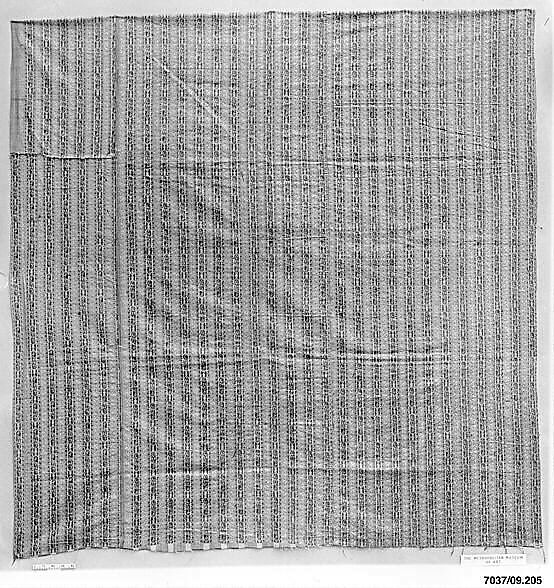
The Met's early nineteenth-century textile 09.205, attributed to India, lists linen, silk, and metal-wrapped thread with a damask weave. Read that compact material line slowly. It is a reminder that ordinary fabric names compress several decisions, and that geographic attribution is evidence to preserve rather than sharpen into an unsupported certainty.
On screen and in play
In an invented screen costume, one broad repeated flower could remain visible through successive shots, helping the audience recognise a character in a crowd. That use depends on pattern scale and framing. A tiny intricate weave may be beautiful in person yet become a single tone at a distance.
Related words Damask · Lamé · Soutache · Waistcoat · Sumptuary laws
