

Homarus
Being a true and faithful accompt of ye armoured beast of Northerne Bay, its habitudes, its anatomie, and its unsettling immortalitie
Of its generall forme
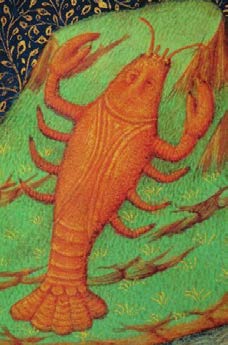
There existeth, in certain unforgiving waters of the Northerne Atlantick, a creature of such improbable devise that one must conclude it was fashioned by some lesser craftsman of the celestial workshop who, having studied the creeping things of the earth and the fishes of the sea, resolved to combine them. Its ten limbes are an excess by any standard of natural philosophy. Two have been fitted with weaponry: one built to crush bone, the other to sever flesh. An instrument of siege and an instrument of surgery.
Its feelers extend beyond the length of its owne body. It heareth, if hearing be the worde, through fine haires upon its legs, which is to say it listeneth to the sea the way a blind prophet readeth the future. Its blood runneth blue. Not in the manner of kings, but in truth, in substance, in alchemical fact, for it bindeth its breath to copper where you and I bind ours to iron.
Of its immortalitie
The creature doth not age, or so it seemeth. An aged lobster is not weaker than a young one. It doth not wither, nor stoop, nor squint at the world through dimming eyes. It doth die, eventually. Not of age, but because the world killeth it: a predator, a pestilence, a trap, or the slow and terrible cost of its own magnificence. For it never stoppeth growing, and to grow it must shed its entire skeleton and forge a new one, until one day the beast is too vast to bear the price of becoming itselfe again. There is, this author submitteth, a parable in this. He shall not be the one to draw it.
Of its armour and its nakednesse
Every few moons the creature splitteth itselfe open along the ridge of its back and draweth forth its own body, every limb pulled through its casing the way one pulleth a hand from a glove sewn too tight. What emergeth is soft, and pink as a newborne, and larger than it was an hour before. For severall weeks it is little more than ambition wrapped in flesh. It hideth. It consumeth its own discarded shell for the calcium therein. Then it resumeth its former life as though nothing of consequence hath occurred. It doth not speak of the ordeal.
Of its manner of conversation
The creature communicateth by urinating from its face. Glands at the base of its antennae release a spray with which it declareth its name, its intent, and its rank. One is put in minde of certain customs among men, though this author hath been counselled by the learned brethren of his Order to pursue the comparison no further.
Of its station in the economies of men
In the colonies of the Newe World, it is told, homarus was fed to prisoners and servants, and farmers cast it upon their fields as dung. That it would one day be presented upon white linens at prices to make a bishop reconsider his supper would have struck any colonial fisherman as proof of a disordered minde. The creature hath not changed.
Whatever madness occurred, it occurred entirely on land.
Of the monument
There existeth, in a certain towne upon the Northumberland Strait, a monument to this creature larger than most houses of men: eleven metres long and ninety tonnes. Visitors arrange themselves beneath its raised claws to have their likenesses taken, with the serene confidence of pilgrims posing before the jaws of a dragon. That a towne should erect its most prominent monument to the very creature it consumeth is a paradox this author hath chosen not to resolve.
The homarus hath long endured. It walked the floor of the ocean when the great lizards ruled the earth. It was walking still when they perished.
In plain English: what’s actually true
- Blue blood: true. Lobster blood carries oxygen with copper (hemocyanin) instead of iron, and it turns blue in air.
- Immortal: no. Lobsters don’t show the usual signs of ageing, which is where the legend comes from, but they do die, often because moulting takes more energy as they grow.
- Moulting: true. A lobster sheds its whole shell to grow, often eats the old one, and stays soft and hidden for weeks.
- Talking through its face: true. Lobsters release urine from glands near the base of the antennae to signal to each other, in courtship and in fights.
- Prison food: a well-loved story with some truth in colonial New England; treat the details as folklore.
- The Giant Lobster: real. It stands at Rotary Park on Main Street in Shediac, unveiled June 30th, 1990, about 11 metres long and 90 tonnes. The Witzend kiosk is right beside it.
Quick answers
Do lobsters really have blue blood?
Yes. Lobster blood carries oxygen with copper-based hemocyanin rather than iron, and it turns blue in air.
Are lobsters immortal?
No. They don’t show the usual signs of ageing, but they do die, often because moulting takes more energy as they grow.
Do lobsters pee out of their faces?
Yes. Glands near the base of the antennae release urine, which lobsters use to signal to each other.
Where is the Giant Lobster?
At Rotary Park on Main Street in Shediac, beside the Witzend kiosk. It was unveiled on June 30th, 1990, and is about 11 metres long and 90 tonnes.
