

Flexible or rigid strips used to support and shape a garment. Modern boning may be steel or synthetic material. The name remembers an older material; the structure needn’t use it.
The longer story
Boning gives a garment a framework. Narrow supporting strips sit within channels or otherwise belong to the construction, helping an area keep its intended shape. The word names their role, not a guarantee about their material. Historical examples and modern costume supplies can use quite different substances while serving a related structural purpose.
The V&A’s account of Victorian underwear places boning alongside other supporting techniques, including cording. That distinction matters: a stiffened appearance does not identify the method by itself. Shaped seams, layers, interlining, cords, and bones may all contribute to a silhouette. Looking only at the outer fabric can conceal most of the work.
Boning should not be treated as a synonym for tightening. A supported garment has to be considered as a complete design, including its pattern, dimensions, closures, and intended wearer. The presence of strips cannot rescue an unsuitable shape. Nor does a photograph establish how comfortable an original garment was, how tightly someone wore it, or what their body looked like underneath. Those are separate claims requiring separate evidence.
At the festival
For a festival costume, identify the intended effect before selecting a structured garment. Is the purpose a smooth bodice line, a particular silhouette, or support for a decorative element? A theatrical outline does not require repeating every material or wearing practice associated with an antique. The finished costume should be assessed on the person who will use it, not on the persuasive posture of a mannequin.
On the page
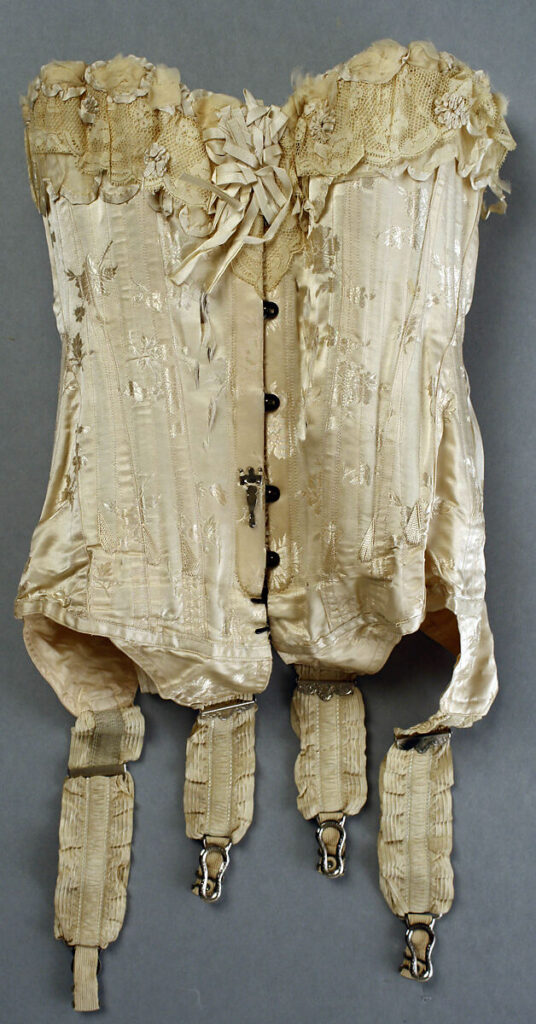
The Met’s record for a French corset identifies silk and metal in its materials. It provides a concrete object to examine alongside the V&A’s broader discussion. A catalogue’s material list still does not reveal every internal detail. Read it as evidence about that particular piece, rather than a recipe for all corsets or all periods.
On screen and in play
In an imagined costume illustration, draw the supporting channels on a separate construction view while leaving the exterior view uncluttered. This explains why a silhouette holds its shape without turning the drawing into body-shaping advice. Our diagram shows channels as a conceptual framework; it is not a historical reconstruction, a fitting guide, or a promise of a particular result.
Related words Toile · Seam allowance · Eyelet · Corset · Garb
