

An embroidery technique in which a thread or cord lies on the surface and is held down with small stitches. Useful when the decorative strand is too thick or delicate to pull through.
The longer story
Couching separates two jobs that a single thread often performs. One thread lies along the surface to provide the visible line. Another makes the smaller stitches that hold it there. The laid thread can therefore be thicker, less flexible, or more decorative than a thread repeatedly pulled through the ground.
The Royal School of Needlework’s entry for couching shows this basic relationship clearly. Its wider group of couched stitches demonstrates that the principle supports many arrangements rather than one fixed appearance. Short holding stitches can disappear into a matching colour or become part of the pattern. A curve, a border, and an area of laid threads present different design problems even when their underlying idea is related.
It is helpful to distinguish an attached cord from a line made entirely of ordinary surface stitches. At a glance both can trace the same outline. Close inspection reveals whether the main line travels through the ground or is held above it. This is a structural distinction, not simply a question of whether the thread looks expensive.
At the festival
On a festival garment, a couched line might make a motif readable from farther away than a fine stitched outline. Imagine a dark coat with a contrasting cord following an original leaf design. The holding stitches need not be invisible; deliberately spaced stitches can add a second rhythm. A sample lets the maker judge weight and flexibility before the decoration occupies a large area.
On the page
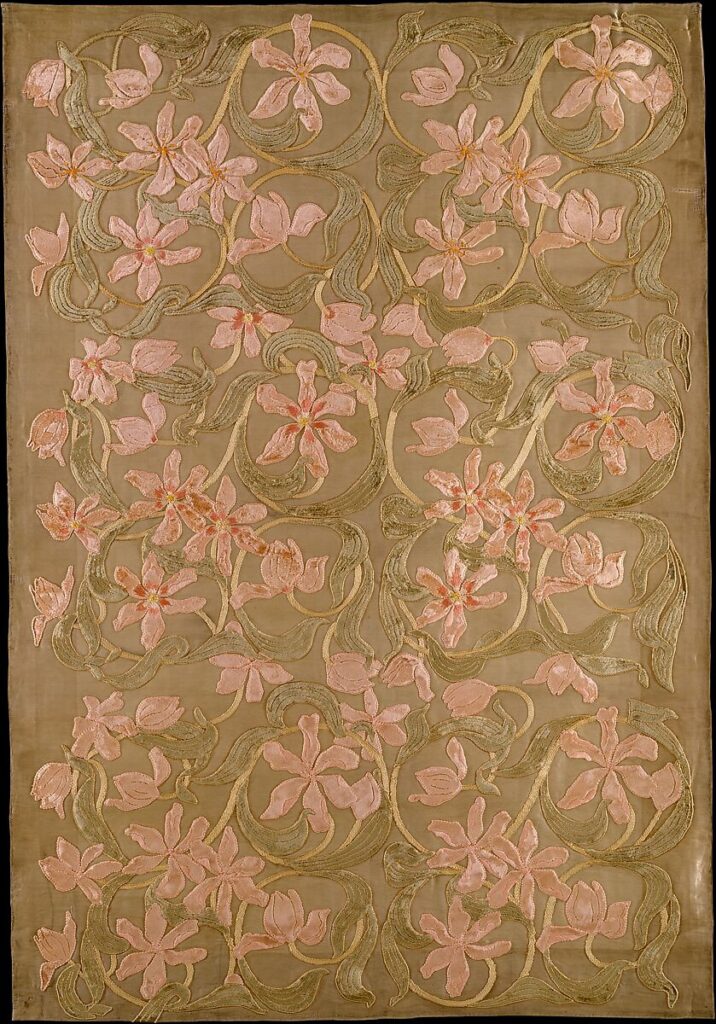
Candace Wheeler’s unfinished Tulips panel, made in New York in 1883–87 and held by the Met, includes appliqué and embroidery. The museum specifically identifies unfinished couching along leaves. An incomplete object can be unusually informative: it leaves different stages beside one another, allowing a reader to connect the finished line with the work still to come.
On screen and in play
For an imagined theatrical close-up, a visible securing thread could become part of a character’s repair rather than disappear as flawless ornament. The story choice is the designer’s; the technique remains a practical relationship between two threads. The accompanying diagram exaggerates their separation so the mechanism is legible, rather than pretending to be a full sewing pattern.
Related words Embroidery · Appliqué · Haberdashery · Garb · Sewing pattern
