

Pieces of fabric attached to a larger textile to make a design. A crest, a leaf, or a patchwork dragon can be built this way. The decoration has edges you can follow.
The longer story
Appliqué builds a design by placing one piece of material on another. A cloth leaf can become a large, readable shape without filling its whole surface with embroidery stitches. Its outline, attachment, and contrast with the ground all contribute to the result. The added material may match the base fabric or behave quite differently from it.
This is not the same construction as patchwork, where separate pieces are joined to make a larger surface. Appliqué has a supporting ground beneath the added shape. Embroidery can secure or decorate that shape, so the techniques are companions rather than mutually exclusive categories. A banner may contain pieced cloth, appliquéd emblems, and stitched lettering in the same object.
Edges matter. A turned edge hides the cut boundary; a deliberately visible raw edge makes a different surface. Neither description alone tells us whether an object is carefully made. The appropriate treatment depends on the material, the intended appearance, and use. On a frequently handled costume, the joins deserve as much attention as the attractive fabric sitting above them.
At the festival
Look at a large emblem from several distances. A complicated shape that delights its maker at a worktable may disappear across a courtyard. For an imagined festival banner, a simple applied leaf with a clear outline could read better than many tiny embroidered veins. Study the movement too: flexible decoration should belong to the cloth, rather than behave like an unexpected stiff panel.
On the page
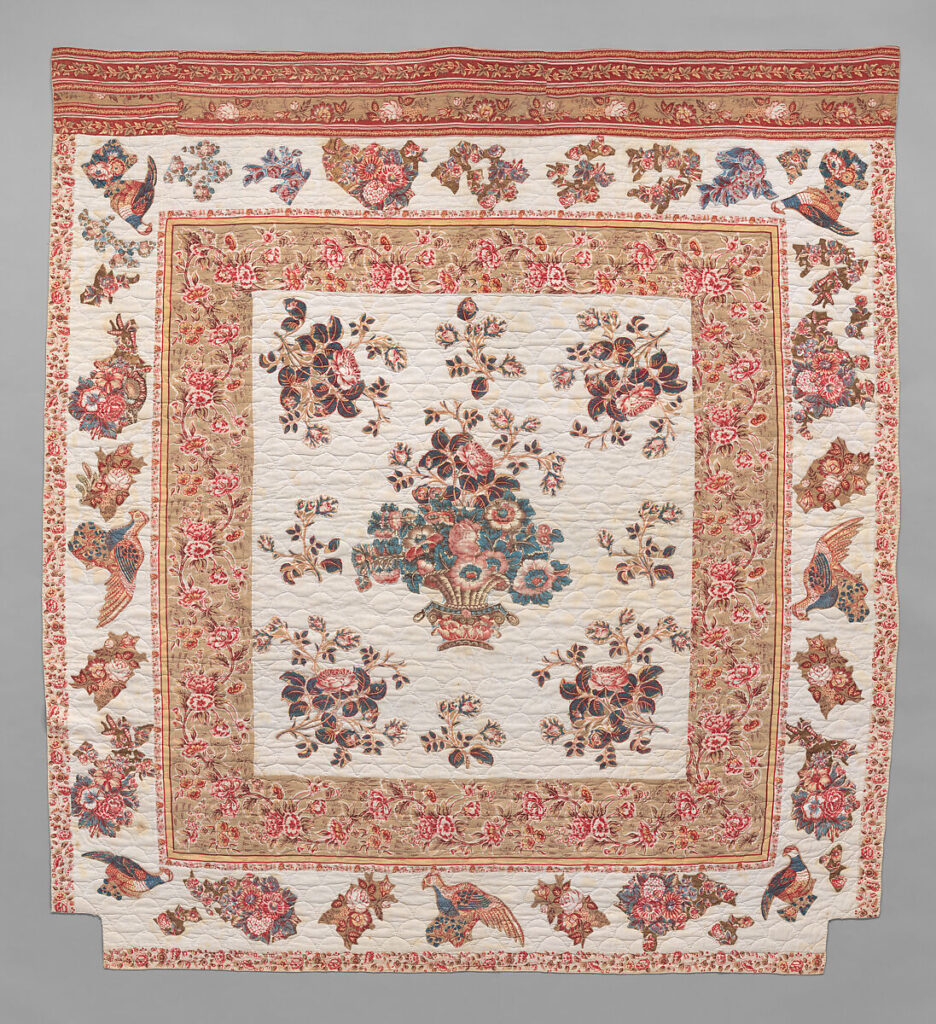
The Met’s Chintz Appliqué Quilt, probably English and dated about 1820–30, places motifs cut from printed cottons on a plain ground. It demonstrates why a first impression can mislead: what resembles one printed cloth is an assembled design. A catalogue helps us distinguish the printed image from the maker’s later arrangement of its pieces.
On screen and in play
In a hypothetical costume design, an appliquéd crest can identify a fictional household at a glance. Its colours and shape can be repeated on a prop or a sign. A bold silhouette can carry across a courtyard, while the stitching rewards a closer look. Repetition gives the imagined world coherence without requiring every visitor to decipher an elaborate family history.
Related words Embroidery · Couching · Felting · Garb · Coat of arms
