

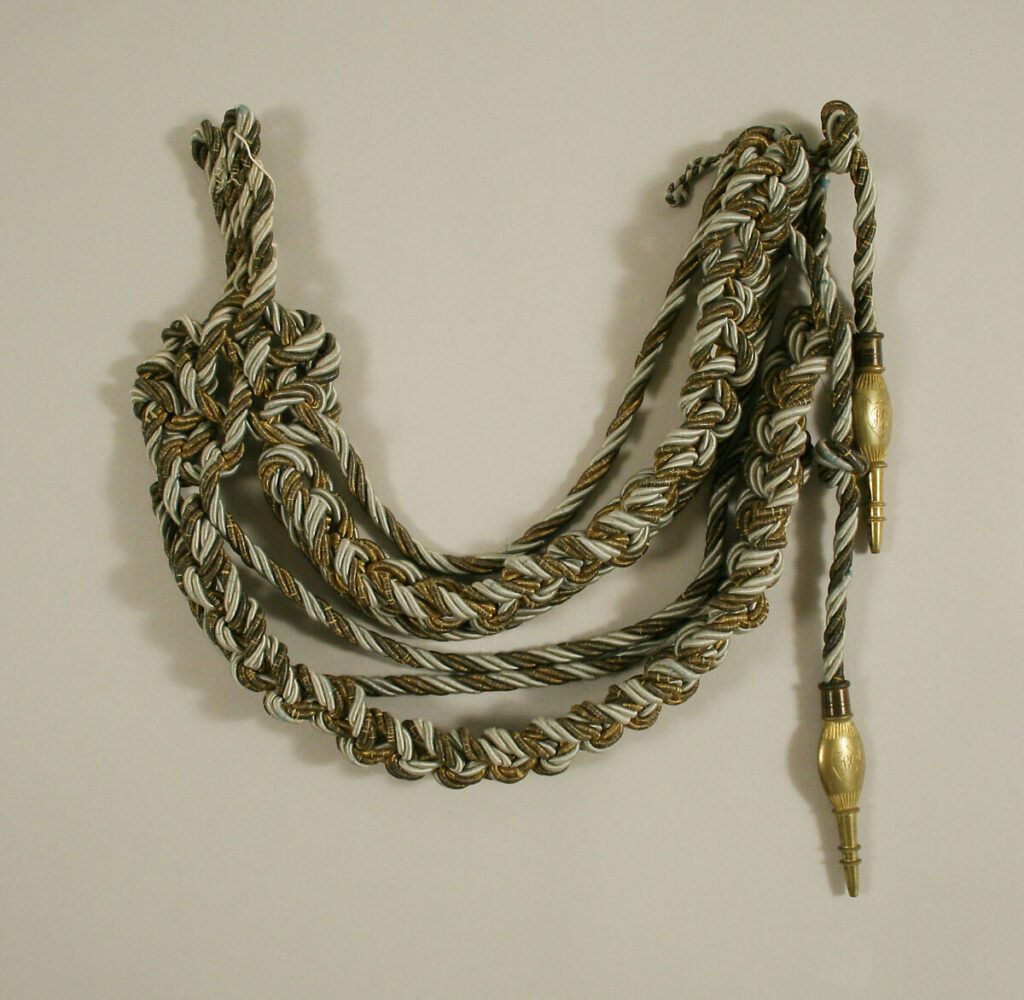
An ornamental cord or arrangement of cords, often with metal tips, worn on a uniform or ceremonial garment. The cord is the aiguillette; a small tip on a lace is an aglet.
The longer story
An aiguillette gives a loose-looking line a very deliberate place. Braided cords may loop under an arm or cross part of the chest, with metal ends making the finish conspicuous. In ceremonial dress, their arrangement can identify a particular appointment. The cord is therefore both textile work and information. Its meaning depends on the uniform system, not on a universal rule that more gold means a higher rank.
National Museums Scotland connects these ornaments with the older world of garment points and arming doublets. Cords once did important joining work between pieces of dress or equipment. The museum is careful about the gap: continuous use from the fifteenth century into later uniform traditions isn't established simply by visual resemblance. A plausible ancestor is not an uninterrupted family tree.
For a surviving object, the Metropolitan Museum of Art holds an Italian aiguillette from the early nineteenth century, accession 26.56.139, made of silk and metal. Those two materials explain much of its effect. The textile bends; the terminal gives the eye a definite ending. This is not the same as an epaulette's shoulder platform or a row of cord fastenings across a coat.
At the festival
For a masquerade character, decide what the cord is saying. A fictional court messenger might have one recognisable loop; a meticulously reconstructed uniform requires its particular reference. Drawing the attachment points first helps make the ornament belong to the garment. Otherwise it can look like an excellent curtain tie that has wandered into government.
On the page
The National Museums Scotland article places a sixteenth-century doublet beside later ceremonial cords. Read it for the distinction between evidence and an attractive origin story. The Met catalogue supplies a second kind of evidence: an actual dated material object, rather than a regulation or a portrait.
On screen and in play
In an invented court drama, the same coat could move between characters while an aiguillette marks the person currently holding an office. It shows how a costume detail can communicate a change of responsibility without adding a speech about the constitution.
Related words Epaulette · Frogging · Passementerie · Livery · Doublet
