

Decorative textile trimmings such as cords, tassels, braids, and fringes. They finish the edges and surfaces of clothing or furnishings. The supporting cast can be remarkably well dressed.
The longer story
Passementerie is a family of textile work rather than the name of one narrow ribbon. Braids, cords, tassels, and fringes can all belong to it. These additions may outline an edge, conceal a join, gather a curtain, or make a garment move differently. Their position is often structural to the design even when their immediate purpose is ornamental. Remove the trimming and the whole composition can lose its punctuation.
A tassel is particularly good at showing the relationship between construction and effect. A gathered hanging element gives a cord a visible ending; repeated strands move independently, catching light and responding to touch or movement. A flat braid does another job. It draws a stable border. The two belong to the same broad craft vocabulary, but they don't offer the eye the same experience.
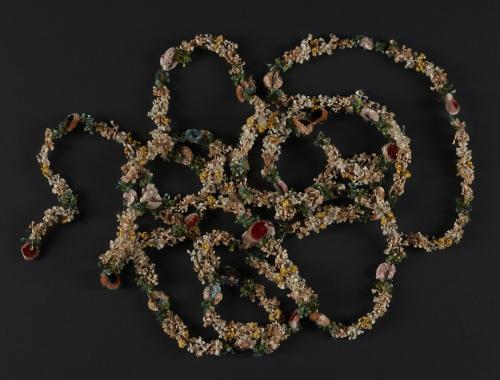
Palais Galliera holds a length of silk passementerie dated 1750–1799, inventory 1995.110.XC. Its recorded length is 4.6 metres. That measurement is worth pausing over: trimming isn't necessarily a tiny final flourish. It can be a substantial material planned across an entire piece of dress or furnishing. The exact original application of this surviving length should not be invented merely because a waistcoat or curtain would look splendid with it.
At the festival
At a masquerade, edges are a useful place to begin looking. A plain cloth may acquire its character from a braid around the opening or a fringe that moves below the sleeve. For an invented costume, repeating one kind of trim can unite separate pieces without making every surface equally busy. The quiet ground gives the skilled border somewhere to speak.
On the page
Compare the Galliera length with the Metropolitan Museum's eighteenth-century Italian silk trimming, accession 08.48.42. The catalogues classify fragments and lengths as objects worthy of attention in their own right. Reading them shifts the focus from the grand finished gown to the people and materials responsible for its smaller components.
On screen and in play
In an imagined room on stage, a heavy fringe can remain still while one loose tassel swings after a character leaves. The trimming then carries a trace of movement. Decoration can keep time.
Related words Soutache · Frogging · Brocade · Maker · Livery
