Passementerie

Decorative textile trimmings such as cords, tassels, braids, and fringes. They finish the edges and surfaces of clothing or furnishings. The supporting cast can be remarkably well dressed.
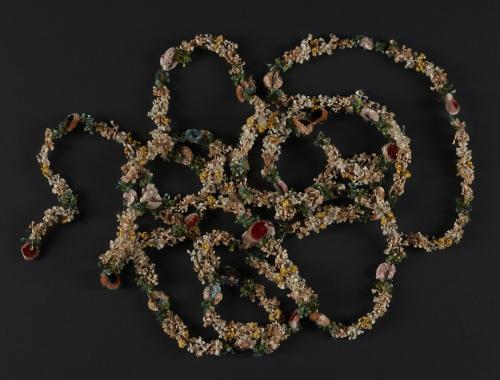
Loops of narrow multicoloured ornamental trim arranged loosely on a dark ground.
Silk passementerie, 1750–1799, Palais Galliera, inventory 1995.110.XC. CC0 Paris Musées / Palais Galliera, musée de la Mode de la Ville de Paris. Museum record · Public domain.
Four textile trimming forms are compared: a twisted cord, flat braid, tassel, and fringe.Passementerie / PassementerieConcept diagram / Schéma de principeCordCordonBraidGalonTasselGlandFringeFrangeOriginal illustration • Shediac Wonderland • 2026
Schematic comparison of the construction and visual role of passementerie; not a reproduction of a historical object. Diagram: Shediac Wonderland.

The longer story

Passementerie is a family of textile work rather than the name of one narrow ribbon. Braids, cords, tassels, and fringes can all belong to it. These additions may outline an edge, conceal a join, gather a curtain, or make a garment move differently. Their position is often structural to the design even when their immediate purpose is ornamental. Remove the trimming and the whole composition can lose its punctuation.

A tassel is particularly good at showing the relationship between construction and effect. A gathered hanging element gives a cord a visible ending; repeated strands move independently, catching light and responding to touch or movement. A flat braid does another job. It draws a stable border. The two belong to the same broad craft vocabulary, but they don't offer the eye the same experience.

Palais Galliera holds a length of silk passementerie dated 1750–1799, inventory 1995.110.XC. Its recorded length is 4.6 metres. That measurement is worth pausing over: trimming isn't necessarily a tiny final flourish. It can be a substantial material planned across an entire piece of dress or furnishing. The exact original application of this surviving length should not be invented merely because a waistcoat or curtain would look splendid with it.

At the festival

At a masquerade, edges are a useful place to begin looking. A plain cloth may acquire its character from a braid around the opening or a fringe that moves below the sleeve. For an invented costume, repeating one kind of trim can unite separate pieces without making every surface equally busy. The quiet ground gives the skilled border somewhere to speak.

On the page

Compare the Galliera length with the Metropolitan Museum's eighteenth-century Italian silk trimming, accession 08.48.42. The catalogues classify fragments and lengths as objects worthy of attention in their own right. Reading them shifts the focus from the grand finished gown to the people and materials responsible for its smaller components.

On screen and in play

In an imagined room on stage, a heavy fringe can remain still while one loose tassel swings after a character leaves. The trimming then carries a trace of movement. Decoration can keep time.

Related words Soutache · Frogging · Brocade · Maker · Livery

Sources

Passementerie

L’ensemble des garnitures textiles comme les cordons, glands, galons et franges. Elles ornent vêtements et ameublement. Les finitions peuvent avoir autant de présence que la pièce qu’elles accompagnent.

Boucles de garniture ornementale étroite et multicolore, disposées librement sur un fond sombre.
Passementerie de soie, 1750–1799, Palais Galliera, inventaire 1995.110.XC. CC0 Paris Musées / Palais Galliera, musée de la Mode de la Ville de Paris. Notice du musée · Domaine public.
Quatre garnitures textiles sont comparées : cordon torsadé, galon plat, gland et frange.Passementerie / PassementerieConcept diagram / Schéma de principeCordCordonBraidGalonTasselGlandFringeFrangeOriginal illustration • Shediac Wonderland • 2026
Schéma de la construction et du rôle visuel : passementerie. Ce dessin ne reproduit pas un objet historique. Schéma : Shediac Wonderland.

L’histoire, plus longue

La passementerie désigne une famille de travaux textiles, pas un seul ruban étroit. Galons, cordons, glands et franges peuvent en faire partie. Ces garnitures soulignent un bord, couvrent une jonction, retiennent un rideau ou modifient le mouvement d’un vêtement. Leur fonction immédiate est parfois décorative, mais leur place dans la composition peut être essentielle. Enlever la finition revient quelquefois à retirer la ponctuation.

Le gland montre bien le rapport entre fabrication et effet. Il termine visiblement un cordon, puis laisse ses éléments mobiles réagir séparément au déplacement et à la lumière. Le galon plat propose autre chose : une bordure stable que l’œil peut suivre. Les deux appartiennent au même vocabulaire général, sans produire la même impression. C’est justement cette diversité qui rend le terme utile.

Au Palais Galliera, la pièce 1995.110.XC est une passementerie de soie datée de 1750 à 1799. Sa longueur indiquée atteint 4,6 mètres. La mesure rappelle qu’une garniture n’est pas nécessairement une petite fantaisie ajoutée à la dernière minute. Elle peut représenter une matière importante, pensée pour parcourir tout un vêtement ou un meuble. En revanche, rien n’autorise à inventer sa destination première parce qu’on l’imagine bien sur un rideau.

Au festival

À la mascarade, les bords offrent un excellent point de départ. Une étoffe sobre peut recevoir tout son caractère d’un galon le long de l’ouverture ou d’une frange sous la manche. Pour une tenue imaginaire, reprendre une même garniture relie les pièces sans charger toutes les surfaces. Le fond tranquille laisse entendre le travail de la bordure.

Dans les livres

La comparaison avec la passementerie italienne du XVIIIe siècle conservée au Metropolitan Museum, numéro 08.48.42, invite à considérer ces fragments comme des objets complets d’étude. Les notices déplacent l’attention : au lieu de ne voir que la grande robe terminée, on remarque les matières et les métiers qui lui donnent ses détails.

À l’écran et en jeu

Dans un décor de théâtre inventé, une lourde frange pourrait rester immobile tandis qu’un gland oscille encore après le départ d’un personnage. La garniture conserve alors une trace de mouvement. Même une finition peut prendre son temps.

Mots voisins Soutache · Brandebourgs · Brocart · Artisan · Livrée

Sources

Wear it to The Shediac Mascarade, the 28th to the 30th of May, 2027.

À porter à la Mascarade de Shédiac, du 28 au 30 mai 2027.