

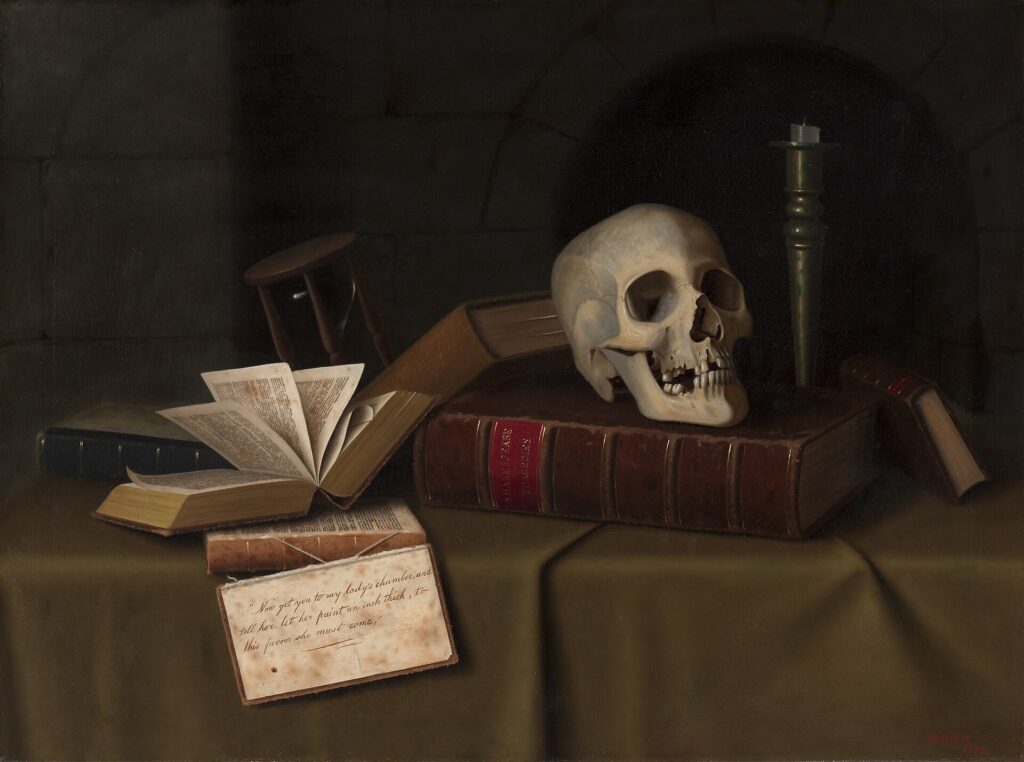
“Remember you must die”: a skull, an hourglass, or a wilting flower placed in art and jewellery as a reminder. The Victorians wore them to parties, which is either morbid or the best possible reason to dance.
The longer story
Strictly, the Latin is an instruction: “remember that you must die,” or, to put the grammar exactly, “remember to die.” The idea is far older than the phrase. Roman tradition imagined a companion standing behind a general at his triumph, reminding him that he was only a man; Tertullian is the only ancient writer to give the words, and his version is hominem te memento, remember you’re human. Seneca urged daily meditation on death, and Epictetus told his students to remember it even while kissing their children, which is either deep wisdom or a very Stoic way to spoil a moment.
The Middle Ages made it visible. Fifteenth-century grandees commissioned transi tombs, with a rotting corpse carved beneath their own effigy, and church walls filled with the danse macabre, in which Death leads pope and peasant alike. In seventeenth-century Holland the reminder became a genre of painting, the vanitas: skulls, guttering candles, wilting flowers, soap bubbles, and hourglasses arranged as beautifully as fruit. Jewellers followed. From the late 1500s through the 1600s, rings, lockets, and brooches carried tiny skulls, bones, and coffins, sometimes with the name of someone already gone, and a skull-shaped watch associated with Mary, Queen of Scots, ticked away with a line from Horace on pale death knocking at hut and palace alike. In colonial America, gravestones sprouted winged skulls. Despite a stubborn legend, Trappist monks don’t greet each other with the phrase, though a small French order of hermits in the 1620s did.
At the festival
At a masquerade a memento mori is the cleverest accessory in the room: it flatters any costume and makes a philosophical point while you dance. A skull ring, an hourglass charm, a pressed flower under glass, or a pocket watch worn on a chain all do the job; the Victorians wore theirs alongside mourning jewellery, but they belong to every century. For a Gothic look, one good piece beats a dozen plastic skulls. And if someone asks what it means, you have the perfect excuse to say “life is short” and ask them for the next waltz.
On the page
Gather ye rosebuds while ye may,
Robert Herrick, “To the Virgins, to Make Much of Time,” Hesperides, 1648
Old time is still a-flying:
And this same flower that smiles to-day
To-morrow will be dying.
The same wilting flower that sits in a vanitas painting, turned into a seduction. Memento mori and carpe diem have always been the same advice, read from opposite ends.
On screen and in play
The skull on a desk, the hourglass running out, and the clock that stops at the hour of a death are among the most borrowed props in film and game design, usually to tell us that someone in the room is running out of time. Mexico’s Day of the Dead keeps a joyful version alive with sugar skulls, and the phrase itself has had a long second life in tattoos, coins, and inspirational posters. Albert Camus put the modern case neatly: come to terms with death, and anything becomes possible.
Related words Mourning jewellery · Victorian · Gothic novel · Cameo · Fantasmagorie · Plague doctor · Séance
