

A ball or party where everyone comes masked, and the usual rules of who may speak to whom are politely suspended until midnight. The original social network, with better outfits.
The longer story
English borrowed the word in the 1590s, from French mascarade or Spanish mascarada, both from Italian mascherata, which comes from maschera, a mask. It took less than a century for the word to sour: by the 1670s a masquerade could also mean any false outward show, which tells you what people suspected went on at the first kind. The masked ball itself had grown out of carnival in Italy, above all in Venice, and out of the costumed dances of the French and Burgundian courts.
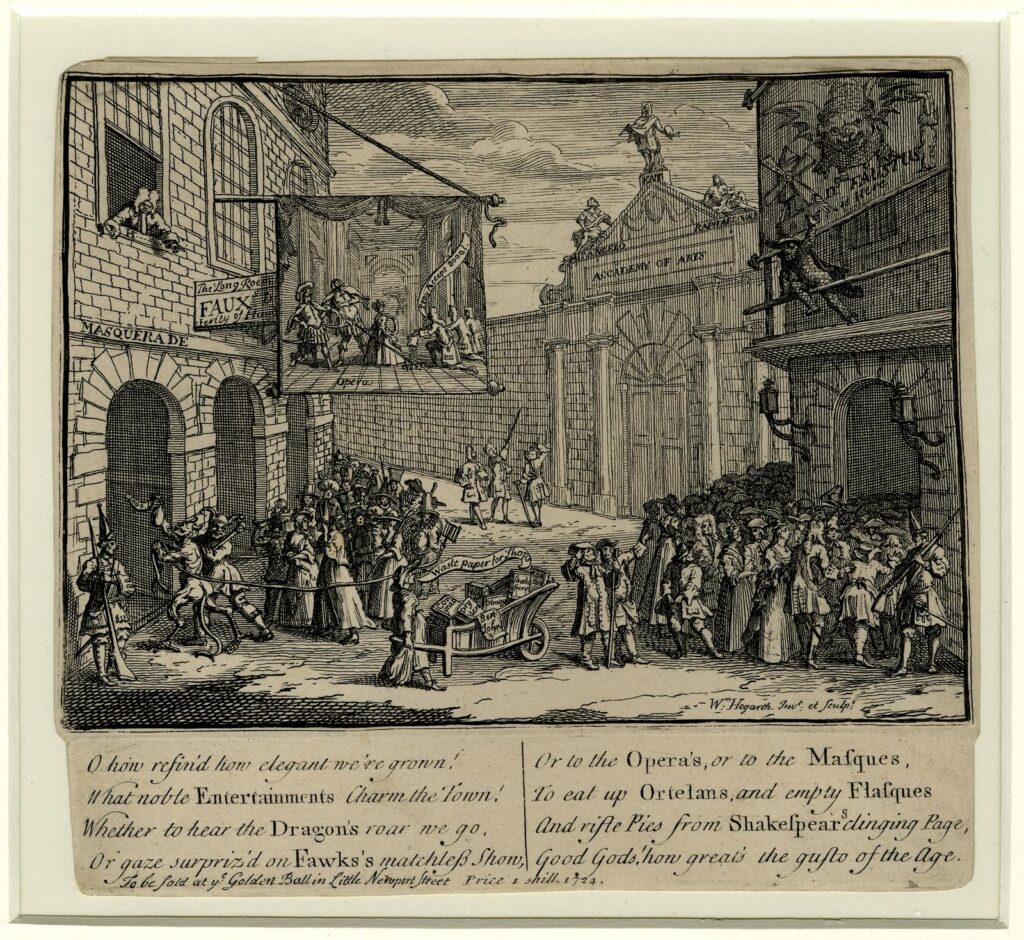
London caught the habit from a Swiss. John James Heidegger, a Zürich clergyman’s son who had landed in England in 1708, began selling masquerade balls at the Haymarket theatre in 1710, and fashionable London took to them at once. The town nicknamed him “the Swiss Count.” Clergymen preached against the balls, Hogarth skewered Heidegger in a 1724 print, Masquerades and Operas, and the crowds kept coming, drawn by precisely the air of danger and mystery the sermons complained about.
The fashion spread to the pleasure gardens at Vauxhall and Ranelagh, where a favourite costume was the “Vandyke,” copied from Van Dyck’s portraits: Gainsborough’s Blue Boy is wearing one. Samuel Richardson and other moralists warned of vice and foreign influence; after the Lisbon earthquake of 1755 some authorities listened, the balls carried on as private subscriptions, and by the 1770s Teresa Cornelys was running them at Carlisle House in Soho Square. The form has never quite gone away. Carlos de Beistegui’s ball at the Palazzo Labia in Venice, on 3 September 1951, and Truman Capote’s Black and White Ball at New York’s Plaza Hotel, on 28 November 1966, are still the two that party planners quote.
At the festival
The eighteenth-century rules still work. At a masquerade anyone may speak to anyone, and nobody may insist on a name. A guest who says “I know exactly who you are” has missed the point; one who says “I have no idea who you are, and I’m enchanted” has understood it perfectly. Stay incognito as long as the evening allows, and save the reveal for the unmasking.
Comfort decides how long the mystery lasts. Test the mask at home with a mirror, a staircase, and a glass of something; if you wear glasses, a loup or a mask on a stick is kinder than a full face. Tie ribbons snugly and carry a spare, plus a few safety pins. If costume isn’t your strong suit, a domino and a half-mask were the eighteenth century’s answer and are still a perfectly honourable one. Whatever you wear, make sure you can dance in it: at a masquerade, the dance card fills faster than you’d think.
On the page
…that temple, where Heydegger, the great Arbiter Deliciarum, the great high-priest of pleasure, presides; and, like other heathen priests, imposes on his votaries by the pretended presence of the deity, when in reality no such deity is there.
Henry Fielding, The History of Tom Jones, a Foundling, 1749, book XIII, chapter VII, “Containing the whole humours of a masquerade”
Fielding sends Tom to the Haymarket and spells its master Heydegger. The joke is that the congregation never minded the empty altar: they had come for each other.
On screen and in play
Stage and screen love a masked ball because it hands the plot a crowd in which anyone could be anyone. The Phantom of the Opera gives its villain a masked ball to crash, dressed as the Red Death; Stanley Kubrick’s Eyes Wide Shut (1999) sends its hero into a far less innocent one. In video games, Dishonored sets a whole mission, “Lady Boyle’s Last Party,” at a masquerade, and The Witcher 3: Wild Hunt and Assassin’s Creed II both send their heroes to one.
Related words Bal masqué · Masque · Domino · Unmasking · Incognito · Carnevale · Dance card
