Fop

A man too devoted to fashion to notice that everyone’s laughing, as opposed to a dandy, who notices and doesn’t care. Restoration comedy was built on him.
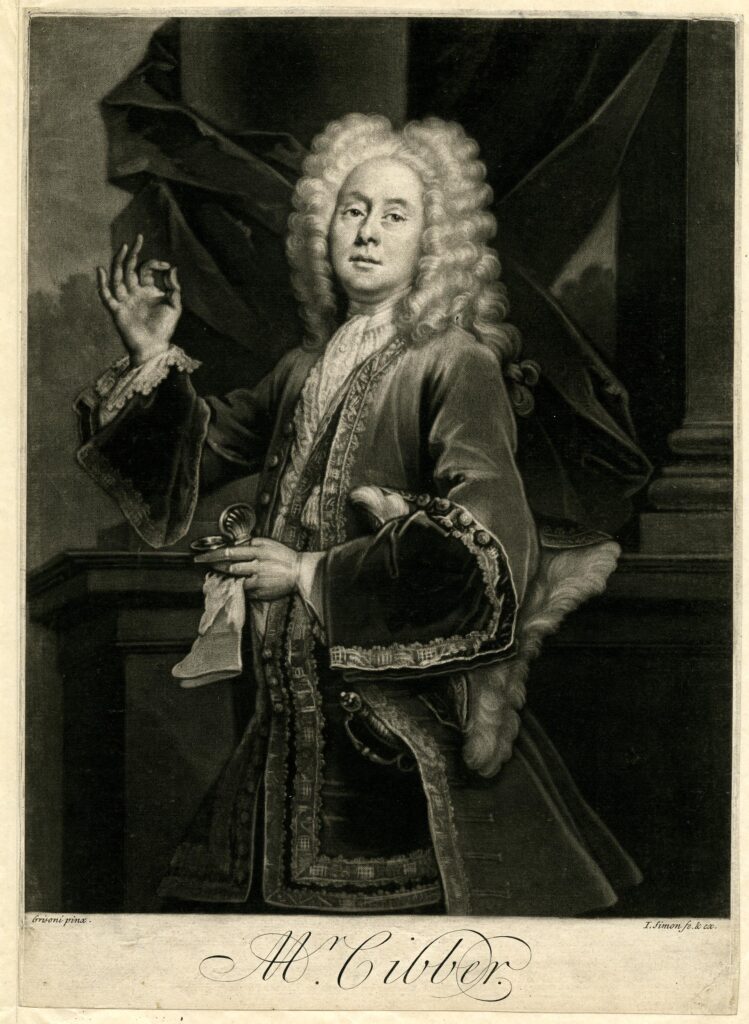
Print of the actor and playwright Colley Cibber, standing three-quarter length in an elaborate wig
John Simon after Giuseppe Grisoni, Colley Cibber, about 1720 to 1730: the man who wrote the fop and played him. British Museum, public domain.

The longer story

For most of its life, a fop was simply a fool. The word turns up in English in 1440, of uncertain origin, and for a couple of centuries it meant a fool of any kind, with no particular interest in clothes. The sense we use now, a man foolishly attentive to his appearance, dress, and manners, appears in the 1670s, and “foppish” and “foppery” followed him into the wardrobe.

The theatre made him a star. Restoration comedy needed someone to laugh at, and the fop was perfect: overdressed, straining after wit, putting on airs, and very fashionably French, in his clothes and in his vocabulary. George Etherege gave him a name and a title role in The Man of Mode, or Sir Fopling Flutter (1676), and John Vanbrugh’s The Relapse (1696) gave the world Lord Foppington, a part the actor Colley Cibber made his own. The stage fop was often a little effeminate, which, the comedies are careful to show, rarely slowed his pursuit of an heiress.

English had a whole wardrobe of near-synonyms (coxcomb, fribble, popinjay), and in the eighteenth century the macaroni took over the most extravagant end of the rack. When the dandy arrived around 1800, he defined himself largely by not being a fop: the fop wanted to be looked at, the dandy wanted to be beyond reproach.

At the festival

Playing a fop is one of the great pleasures of a masquerade, because the costume and the character are the same joke. Lace at the cuffs, ribbons everywhere, a curled wig, a fan used for emphasis, and a quizzing glass raised at anything mildly surprising. The trick is generosity: a good fop makes himself the butt of the joke and flatters everyone else extravagantly. Sprinkle in a little French, compliment strangers’ costumes, and go light on the perfume, because the person next to you in the grand march has a nose too. Stay in character as long as it’s fun for the people around you, and not one curtsy longer.

On the page

Go to the creating a whole tribe of fops, / Got ’tween asleep and wake?

William Shakespeare, King Lear, act I, scene 2, Edmund

Edmund, the bastard son, sneers that children made in a dull, tired marriage bed come out a tribe of fools. Shakespeare’s fops are still the old kind, witless rather than well dressed. The play’s first recorded performance, before James I, was on 26 December 1606, the very year the Faire is set in.

On screen and in play

The cleverest fop in fiction is a disguise. In Baroness Orczy’s The Scarlet Pimpernel, a stage play in 1903 and a novel in 1905, Sir Percy Blakeney hides his rescues of French aristocrats behind the persona of a dim-witted, foppish playboy. Leslie Howard played him in the best-known film, in 1934, and Sir Percy is often credited with establishing the hero with a secret identity, a line that runs through Zorro to Batman.

Related words Dandy · Macaroni · Cravat · Persona · In character · Fan

Sources

Petit-maître

Homme trop dévoué à la mode pour remarquer qu’on rit de lui, à la différence du dandy, qui le remarque et s’en moque. La comédie de la Restauration anglaise s’est bâtie sur lui.

Gravure de l'acteur et dramaturge Colley Cibber, debout, à mi-jambes, coiffé d'une perruque élaborée
John Simon d’après Giuseppe Grisoni, Colley Cibber, vers 1720 à 1730 : l’homme qui a écrit le petit-maître et qui l’a joué. British Museum, domaine public.

L’histoire, plus longue

Le français a son fop bien à lui : le petit-maître. L’expression a eu une drôle de carrière. En 1605, elle désignait le diable; avant 1614, le connétable de Montmorency l’employait, paraît-il, pour parler du roi; en 1651, on appelait ainsi les familiers du prince de Condé. Le sens moderne s’installe à la fin du siècle : un jeune élégant à la mise recherchée, à l’allure maniérée et prétentieuse. Sa consœur, la petite-maîtresse, le rejoint peu après.

L’anglais fop a suivi le chemin inverse. Au XVe siècle, c’était un sot, tout simplement; il ne devient un homme vain de sa toilette que dans les années 1670. Et c’est la comédie de la Restauration anglaise qui en fait une vedette : trop habillé, avide de bons mots, pétri d’airs et volontiers francisé jusque dans son vocabulaire. Sir Fopling Flutter chez Etherege (1676), lord Foppington chez Vanbrugh (1696) : à Londres, le ridicule parlait français.

Au siècle suivant, le macaroni reprend le flambeau de l’extravagance. Puis arrive le dandy, qui se définit surtout par ce qu’il n’est pas : le petit-maître veut qu’on le regarde, le dandy veut qu’on n’ait rien à lui reprocher.

Au festival

Jouer les petits-maîtres est l’un des grands plaisirs d’un bal masqué, puisque le costume et le personnage font la même blague. Dentelle aux poignets, rubans partout, perruque bouclée, éventail pour ponctuer ses phrases et lorgnon levé au moindre étonnement. Le secret, c’est la générosité : un bon petit-maître se moque de lui-même et couvre les autres de compliments. Quelques mots d’anglais bien snob feront l’effet inverse de Londres, et le parfum se dose avec retenue, car le voisin de grande marche a lui aussi un nez. On reste en personnage tant que l’entourage s’amuse, pas une révérence de plus.

Dans les livres

« Les gens de qualité savent tout sans avoir jamais rien appris. »

Molière, Les Précieuses ridicules, 1659, scène X, Mascarille

Mascarille est un valet qui joue les marquis pour éblouir deux précieuses entichées de beau langage. En une phrase, il livre toute la doctrine du petit-maître : l’élégance tient lieu d’instruction.

À l’écran et en jeu

Le plus habile des petits-maîtres de fiction est un déguisement. Dans Le Mouron rouge de la baronne Orczy, pièce en 1903 puis roman en 1905, sir Percy Blakeney cache ses sauvetages d’aristocrates français derrière le personnage d’un dandy écervelé et frivole. Leslie Howard l’incarne dans le film le plus connu, en 1934, et on attribue souvent à sir Percy l’invention du héros à double identité, de Zorro jusqu’à Batman.

Mots voisins Dandy · Macaroni · Cravate · Personnage · En personnage · Éventail

Sources

Wear it to The Shediac Mascarade, the 28th to the 30th of May, 2027.

À porter à la Mascarade de Shédiac, du 28 au 30 mai 2027.