

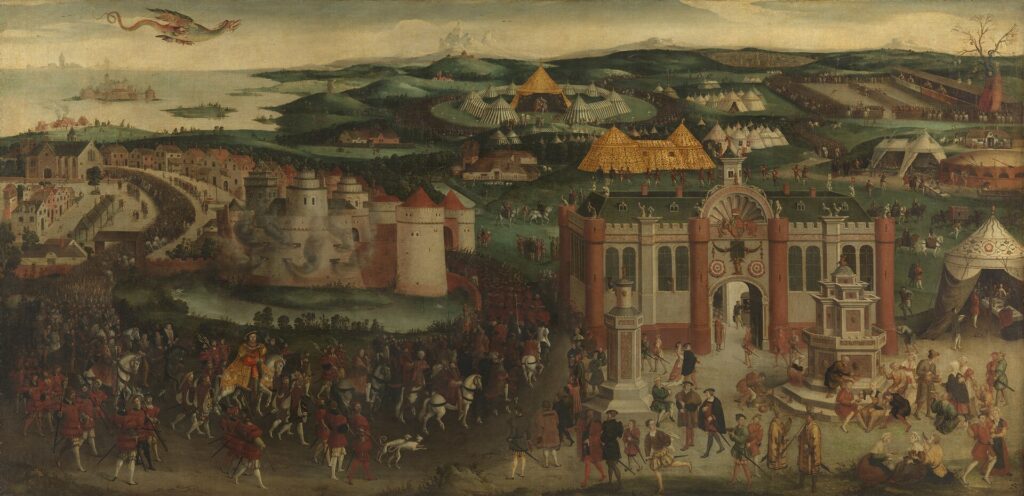
The monarch and the nobles, ladies, and officers around them. At a faire, the court holds audience, settles disputes, and occasionally knights a child who asked very politely.
The longer story
A court started as a yard. The word comes through Old French cort from the Latin cortem, an enclosed yard, and slid from the space to the people gathered in it; in English it meant a sovereign’s residence by about 1200 and a place of judgment by about 1300. Good behaviour borrowed the name too. “Courteous” first described someone with courtly manners, and in the 1570s “to court” someone meant to win their favour with the attentions a courtier paid a prince.
Early courts were on the road. Many Western European monarchs moved from residence to residence with their whole household, and only from the mid-1200s did courts settle more often in fixed centres. The household’s offices kept their old titles long after the duties had gone ceremonial: chamberlain, steward, seneschal, butler, master of the horse, lady-in-waiting. Etiquette grew to match. In the late 1400s Aliénor de Poitiers wrote down the rules of the Burgundian court, the most elaborate of its day, and under Louis XIV Versailles took court ceremony as far as it would go. The habit lingers: foreign ambassadors to the United Kingdom are still accredited to the Court of St James’s, though the monarch actually holds court at Buckingham Palace.
At the festival
At a faire the court is the cast that never stops performing. The monarch processes, a herald announces, and courtiers gossip in character all day, so a polite question about the latest intrigue is usually rewarded with far more than you asked for. When the court holds audience, petitioners are welcome: a grievance against a neighbour, a request for a title, or a plea for clemency on behalf of a friend all tend to go over well, especially if presented with a bow. Most faires are happy to see you play along; a courtier’s insult is part of the show, and the right answer is a better one. If the monarch passes, a bow or a curtsy costs nothing. And yes, children do occasionally leave as knights: see knighting for the etiquette.
On the page
…to use in every thyng a certain Reckelesness, to cover art withall, and seeme whatsoever he doth and sayeth to do it wythout pain, and (as it were) not myndyng it.
Baldassare Castiglione, The Book of the Courtier, 1528, book one, in Sir Thomas Hoby’s translation of 1561
Castiglione’s word was sprezzatura, and Hoby had to invent an English one for it. The ideal courtier works very hard at seeming not to work at all, which remains excellent advice for anyone wearing a ruff in the heat.
Related words Herald · Knighting · Dame · Procession · Jester · Sumptuary laws · Livery
