

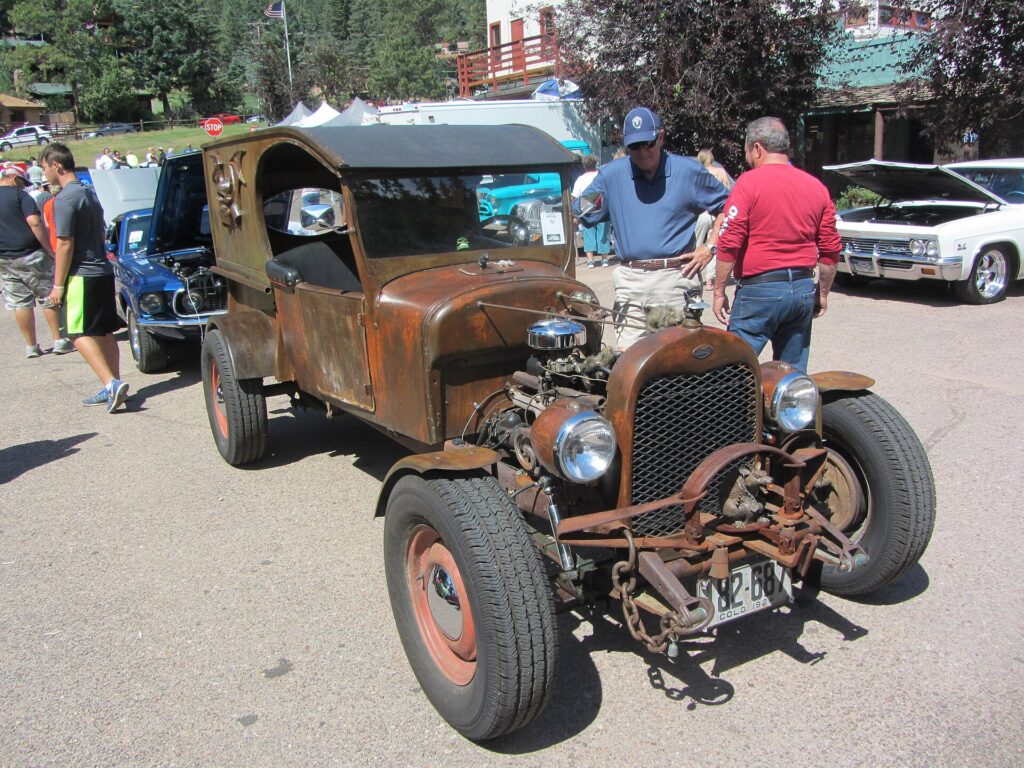
A hot rod built deliberately unfinished: bare metal, surface rust, exposed welds, and an engine that announces itself from three streets away. The wasteland‘s idea of a luxury car.
The longer story
First came the hot rod. In the late 1930s, young Californians stripped old Fords, Model Ts, Model As, and the 1932 to 1934 Model Bs, and raced them on the dry lake beds northeast of Los Angeles under the rules of timing associations. After the Second World War the hobby boomed, helped by returning soldiers with mechanical training and empty little airfields to race on. Hot Rod magazine started in 1948, and the National Hot Rod Association was founded in 1951 to move drag racing off the streets. The name probably comes from “hotting up” an engine; the “rod” may be the roadster body or the camshaft inside it. Before that, a souped-up car was a “gow job.”
The rat rod is the hot rod’s scruffy grandchild, and a protest. As show cars grew so expensive that their owners hardly dared drive them, some builders went the other way: primer or flat black instead of paint, original paint and rust left as “natural patina,” parts from wherever, and a car meant above all to be driven. The term is credited to Anthony Casteneda of the Shifters, a Southern California car club, in the early 1990s, probably as an insult at first, and borrows from the “rat bike” built of spare parts. A 1972 Rod & Custom feature on the cheap “beater” is counted as a forerunner. The details are half the fun: wrenches for door handles, hand saws for sun visors, Mexican blankets and bomber seats inside. Traditionalists called them cheap and talentless; car shows now give them sections of their own.
At the festival
Most of us won’t arrive in one, but the rat rod is a superb costume vocabulary. Flat black and primer grey, bare steel at the edges, a little honest rust, and hardware that used to be something else (a wrench for a belt buckle, a gauge on a bracer, a spark plug on a cord) say Afterland in the most mechanical accent. Coveralls, a welding cap or goggles, and a rag in the back pocket complete the driver.
If you do bring a vehicle, read the festival’s rules on vehicles and art cars first, and remember that anything driven on public roads still has to pass its provincial safety inspection, however apocalyptic it looks. At any car show, look with your eyes: the owner of a deliberately rusty car is just as protective of it as the owner of a gleaming one, and exhaust pipes stay hot long after the engine stops. The rat rod’s whole philosophy fits the wasteland: drive it, fix it, and never mistake shine for worth.
On the page
“Glorious, stirring sight!” murmured Toad, never offering to move. “The poetry of motion! The real way to travel! The only way to travel!” … “O bliss! O poop-poop! O my! O my!”
Kenneth Grahame, The Wind in the Willows, 1908, chapter II, “The Open Road”
A motor car has just run Toad’s horse-drawn caravan into a ditch, and Toad, sitting in the road, falls instantly and permanently in love. Every builder of a loud, impractical car knows exactly how he feels.
Related words Art car · Convoy · Dieselpunk · Patina · Rust effect · Chrome · Salvage
