

Strictly, 1811 to 1820, when the future George IV ruled as Prince Regent for his father. Loosely, the whole Jane Austen era: Empire waists, cravats, assemblies, and a great deal of meaningful glancing across rooms.
The longer story
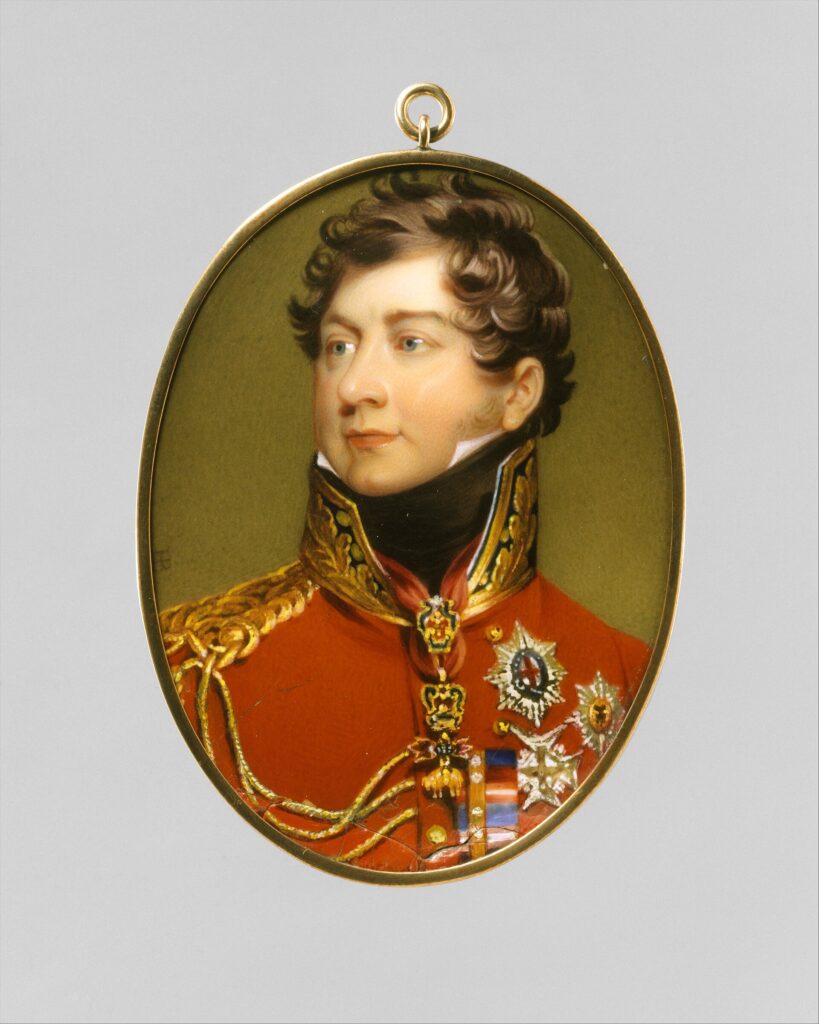
Strictly speaking, the Regency lasted nine years. George III relapsed into his final mental illness in 1810, and under the Regency Act 1811 his eldest son governed in his place as Prince Regent from 5 February 1811 until 29 January 1820, when the old king died and the Regent became George IV. Loosely, and far more usefully for anyone choosing a costume, the name stretches across the whole period from about 1795 to Victoria’s accession in 1837, the bridge between the Georgian world and the Victorian one.
It was an age of war and of spending. Britain was caught up in the Napoleonic Wars until Waterloo in June 1815, and in the War of 1812 with the United States over shipping and territory. At home there was hardship: an exceptionally bad harvest in 1816, and the Peterloo Massacre in 1819. The Regent, meanwhile, ordered the costly rebuilding of his exotic pavilion at Brighton and a grand new route through London, Regent Street, lined with buildings by John Nash.
It was also a golden age for the pen and the needle. Jane Austen, Lord Byron, and Walter Scott were its best-known writers, and Mary Shelley wrote Frankenstein during it. Women wore the high empire waist and men the starched cravat and the dark, close-cut coat of the dandy.
At the festival
Regency is one of the easiest periods to dress for well: a pale high-waisted gown with a spencer, shawl, and bonnet; or a tailcoat, waistcoat, cravat, and boots. Keep the crinolines and bustles for a Victorian night, because nothing breaks the spell like a hoop skirt at Austen’s assembly. One bilingual trap worth knowing: in French, la Régence usually means a different regency entirely, Philippe d’Orléans’s in France from 1715 to 1723, so a francophone guest invited to a “bal Régence” may well arrive in a full wig and the fashions of 1715. If the invitation means Austen, it helps to say so.
On the page
There was a sound of revelry by night, / And Belgium’s capital had gathered then / Her Beauty and her Chivalry, and bright / The lamps shone o’er fair women and brave men;
Lord Byron, Childe Harold’s Pilgrimage, canto III, 1816, stanza XXI
Byron is describing the Duchess of Richmond’s ball in Brussels on 15 June 1815. The Duke of Wellington was there; shortly before supper he learned that Napoleon was advancing, and the officers left the dance floor for the battlefield.
On screen and in play
The BBC’s Blackadder the Third (1987), six episodes set loosely in the Regency, gave the world Hugh Laurie as a spoiled, foppish, gloriously dim Prince George, opposite Rowan Atkinson’s scheming Blackadder. In the last episode a duel goes wrong, and Blackadder ends up posing as the Prince Regent for good. The Richmond ball itself keeps returning in fiction, in Thackeray’s Vanity Fair and in Georgette Heyer’s An Infamous Army (1937).
Related words Empire waist · Dandy · Cravat · Spencer · Waltz · Victorian · Debutante
